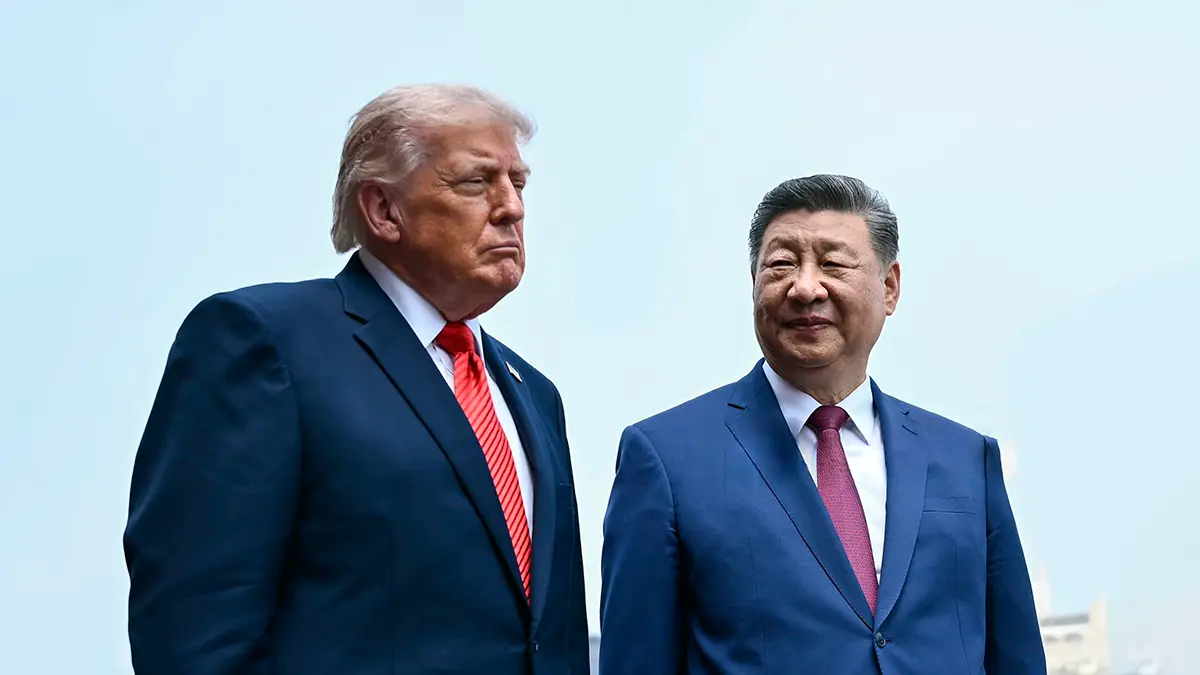
Mid-flight, Trump avoids committing to defending Taiwan after a direct question from Xi Jinping in Beijing.
The US president stated aboard Air Force One that he would not publicly answer questions about potential military support for the island, after the Chinese leader placed the issue at the center of the bilateral summit.
Donald Trump chose not to clarify whether the United States would intervene in defense of Taiwan against a potential Chinese offensive, at the end of a two-day meeting in Beijing that once again placed the balance of power in the Asia-Pacific region at the forefront of the international agenda.
The issue was one of the most closely watched after the meeting with Xi Jinping, but the US president decided to maintain Washington’s traditional caution on this matter.
Back in the US, during the presidential flight, Trump explained to the press that Xi himself had asked him the question directly and that he preferred not to make any public statements.
In doing so, he avoided commenting on one of the most sensitive points in the relationship between Washington, Beijing, and Taipei.
The decision fits with the historical line of strategic ambiguity that has characterized US foreign policy regarding Taiwan.
Sheinbaum and Trump Resume Dialogue and Reaffirm Coordination on Security and Trade Affairs
This approach avoids explicitly confirming whether there would be a military response in the event of an attack, while simultaneously maintaining security ties with the island and adhering to the diplomatic framework of the One China policy, under which Washington recognizes Beijing’s position without necessarily endorsing all its implications.
From the outset of the summit, Xi Jinping made clear the importance his government attaches to the Taiwan issue.
According to reports published by the state news agency Xinhua and picked up by international media outlets such as Al Jazeera and TIME, the Chinese president warned that an inappropriate handling of this issue could lead to clashes and even conflicts between the two powers, as well as jeopardize the entire bilateral relationship.
In the days leading up to the meeting, various analysts anticipated that China would seek to harden the official US rhetoric on Taiwanese independence.
The expectation revolved around a potential shift in rhetoric, moving from a stance of non-support to one of open opposition—a diplomatic nuance that, while seemingly minor, would have direct implications for the deterrence architecture and the strategic message Washington projects in the region.
Trump also left open the possibility of an arms package for Taiwan, noting that the matter had been discussed in detail and that no final decision had yet been reached.
His comment suggests that the White House is seeking to maintain room for maneuver at a time of heightened geopolitical sensitivity.
Beyond this specific statement, the meeting in Beijing confirmed that Taiwan remains one of the most sensitive points in the relationship between the United States and China, with the potential to redefine the bilateral relationship, as well as the strategic stability of one of the world’s most crucial regions.