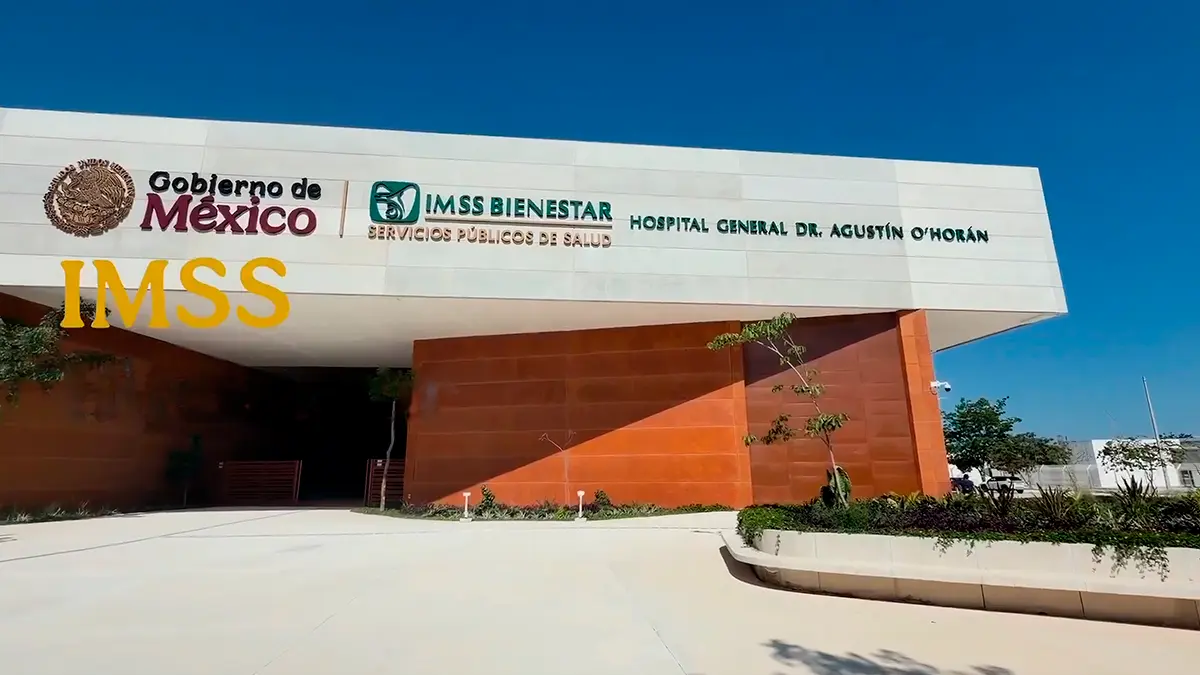
This is what Claudia Sheinbaum said today about the change that promises to transform healthcare in Yucatán with the new O’Horán Hospital.
The opening of the new Dr. Agustín O’Horán General Hospital marked a high-impact day for Yucatán.
President Claudia Sheinbaum led the inauguration of the medical complex and linked the event to a new era for public health services in the state.
In Mérida, the governor presented the opening of a large-scale hospital infrastructure and confirmed Yucatán’s adherence to the IMSS-Bienestar model, through which care for people without social security will advance under a free healthcare scheme.
The inauguration of the new Dr. Agustín O’Horán General Hospital placed Mérida at the center of a key day for the public health agenda.
The event took place on May 17 and was presented by the federal government as a significant step toward expanding hospital capacity in southeastern Mexico.
During the visit, Sheinbaum also signed the agreement to integrate Yucatán into the IMSS-Bienestar system.
This decision paves the way for health services for people not affiliated with the IMSS or ISSSTE to operate free of charge, under a model focused on public coverage and universal healthcare.
This is the new hospital complex that is now operational in Mérida
The new medical unit was designed as a large-capacity complex.
Official information indicates that the hospital comprises 10 functional buildings, 669 hospital beds, 82 consulting rooms, and spaces dedicated to critical care, intensive care, and hospitalization. It also offers more than 48 medical specialties.
The equipment also places this facility among the most important in the region’s healthcare sector.
The complex has 16 operating rooms, and depending on the available coverage, two of them are equipped with robotic technology for minimally invasive procedures.
It also incorporates state-of-the-art laboratories and specialized areas for oncology, hemodialysis, and hemodynamics.
Among the support elements for urgent care, the hospital has a helipad. This infrastructure facilitates air transfers and expands response capacity in emergency situations, especially when rapid mobilization of critically ill patients is required.
Trump Hardens Stance Against Iran and Increases Pressure on Agreement
Beyond its sheer size, the new Dr. Agustín O’Horán General Hospital represents a commitment to strengthening public health infrastructure in southeastern Mexico.
The combination of hospital expansion, highly specialized equipment, and free services aims to reduce gaps in care and address a long-standing need in the region.
The significance of this announcement also lies in its territorial impact. For thousands of families in Yucatán and the south-southeast of the country, the opening of this hospital could mean fewer trips outside the state and a greater opportunity to receive specialized care closer to home.
In political and social terms, the inauguration showcases a large-scale project and also establishes a narrative of public expectation regarding what a modern health system should offer: coverage, quality, timeliness, and dignified treatment.
From now on, this will be the true benchmark by which the public will measure the scope of this new era.