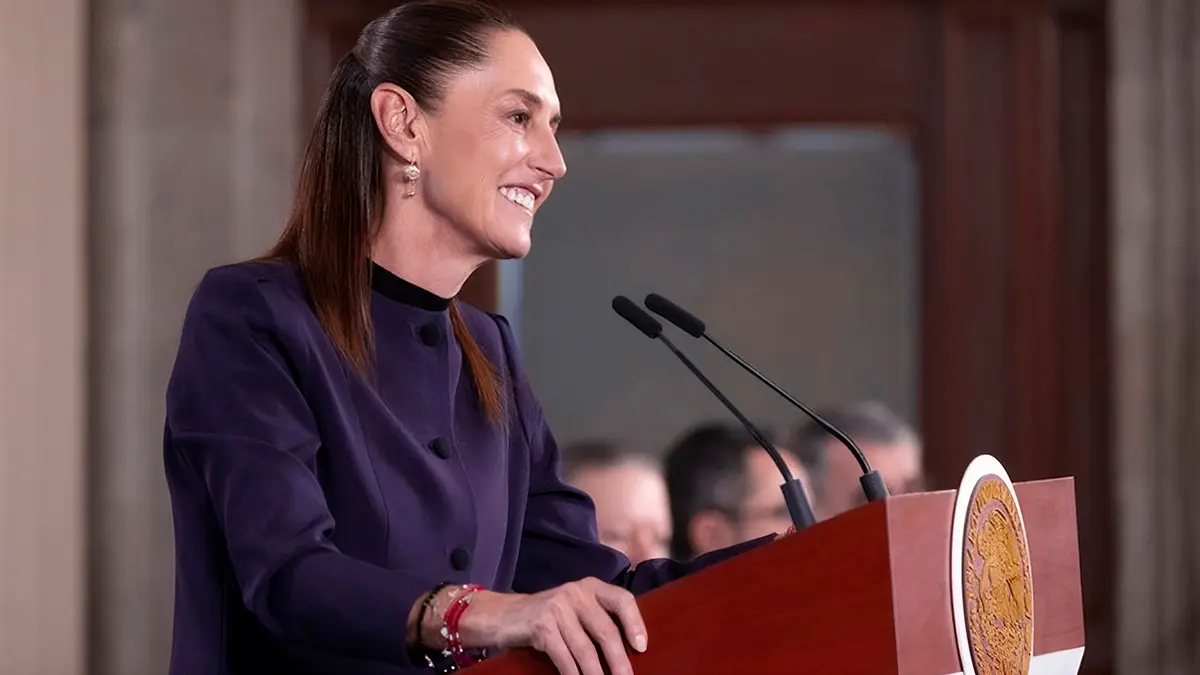
This is what Claudia Sheinbaum said, her staunch defense of Mexico’s sovereignty, and the message that ignited the political debate.
President Claudia Sheinbaum asserted that there are sectors both within and outside the international community that reject Mexico’s political autonomy.
Her stance, delivered from the National Palace, once again placed the issue of sovereignty at the center of public discussion.
During her morning press conference, Sheinbaum maintained that there are political and economic currents that do not look favorably upon Mexico maintaining its own course in its internal decisions and in its foreign relations.
The president located this resistance both in sectors of the United States and in what she described as an international right wing uncomfortable with a country that seeks to chart its own course without accepting impositions.
In her message, the president described Mexico as a nation that relies on its citizens, defends its institutional dignity, and maintains an agenda focused on social welfare.
Without repeating her exact words, the central idea was clear: a government that does not submit to foreign interests creates discomfort among those who would prefer a relationship of political or economic dependence.
The speech also included criticism of powerful groups who, from her perspective, would like to see Mexico aligned with foreign financial, media, or corporate interests.
This was a significant point. It came at a time of political tension and constant scrutiny of the bilateral relationship with the United States, a relationship that the Mexican government insists on conducting under rules of cooperation, but without subordination.
Sheinbaum also reaffirmed that the foundation of her administration lies in its relationship with the citizens.
This is What Claudia Sheinbaum Said About the New O’Horán Hospital in Yucatán
Under this logic, she argued that defending sovereignty cannot be separated from the obligation to govern with a social focus.
In her narrative, national independence is not only a diplomatic principle, but also a condition for promoting public policies aimed at the well-being of the majority.
The statement aligns with a line of discourse that President Claudia Sheinbaum has maintained in various recent speeches: Mexico can coordinate with other governments, but it must do so with respect for its laws, its Constitution, and its decision-making capacity.
In this context, she reiterated that the fight against crime and the governance of the country must respond to national priorities and not to external pressures.
The message is significant because it reopens a historical debate in Mexican politics.
Every time sovereignty is at the center of the discussion, questions also resurface about the type of relationship the country should maintain with foreign powers, especially with its main partner and neighbor to the north.
On this occasion, the president chose a firm tone to establish her position in this scenario.
Beyond the immediate political impact, the intervention leaves a message with symbolic weight.
The presidential narrative seeks to position sovereignty as the cornerstone of legitimacy, identity, and governance.
This emphasis not only responds to the international context but also forms part of a strategy to consolidate a domestic discourse in which independence, dignity, and popular support appear as inseparable elements.