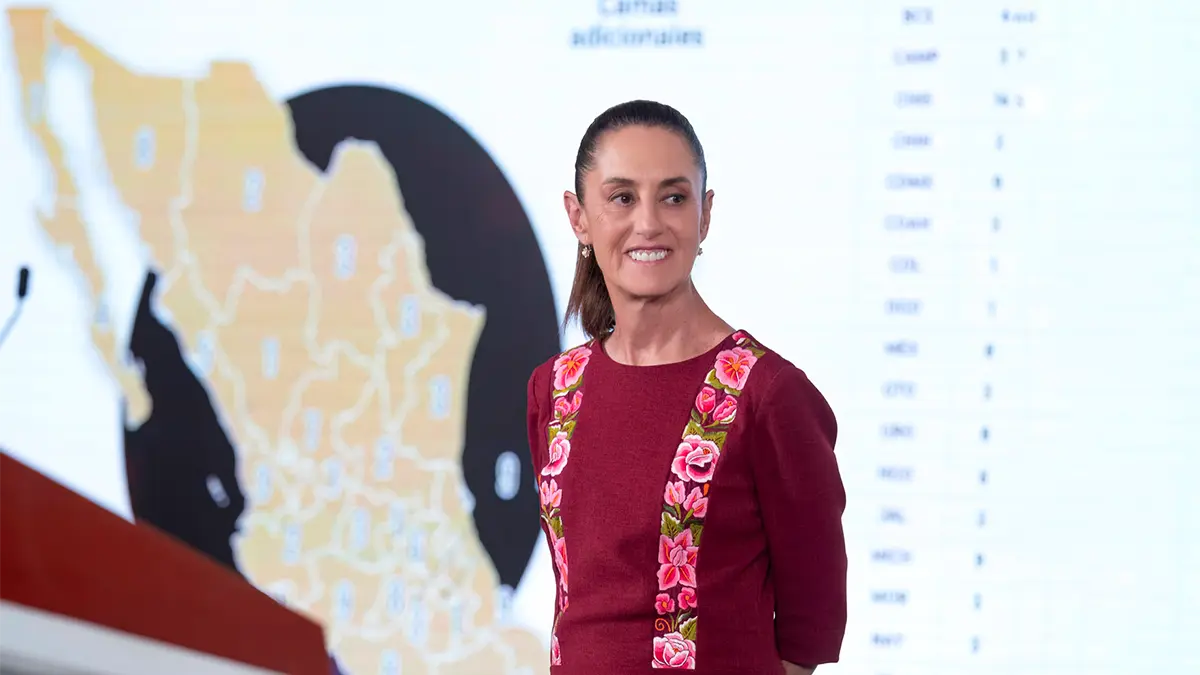
Sheinbaum Reveals Plan for Mexico to Regain Ground in Drug Production
Drug production is once again at the center of public debate, as Claudia Sheinbaum outlines a strategy to strengthen domestic manufacturing and reduce the external dependence that has hampered the healthcare system’s supply for years.
In this plan, Birmex regains a key role, as the state-owned company is positioned as an operational component to expand capacity, coordinate efforts, and participate in initiatives that include research, production, and collaboration with private laboratories.
The plan is being developed jointly by the Ministry of Health and the Ministry of Economy, with the goal of not only manufacturing more medicines but also attracting investment, creating specialized jobs, and strengthening the technological base.
The proposal gains momentum following a recent development: in February, the government announced an agreement between the Ministry of Health, Birmex, Liomont, and Moderna to boost the production of mRNA vaccines.
Felipe VI Responds to Sheinbaum and Confirms his Visit to Mexico for the World Cup
This agreement is understood as a health measure, but it is also interpreted as a sign that the government is trying to rebuild lost industrial capacity in a sector strategic to the public response.
The president indicates that the official presentation will take place in the coming days, at which point the issue will move beyond a general intention and begin to take shape as a public policy with economic and social implications.
For years, Mexico has depended on supplies, active ingredients, and medications manufactured abroad, a reality that exposes the system to delays, increased costs, and logistical pressures that affect the institutional response.
Therefore, the push for local manufacturing is beginning to be presented as a state decision, since the conversation is no longer solely about production but also involves health sovereignty, innovation, and responsiveness.
The project envisions the participation of national and international companies seeking to expand operations in Mexico, while the official strategy is to link this expansion with local production and direct benefits for the country.
This is What the Treasury Says About the Blocking of Rubén Rocha Moya
Another key aspect is the relationship with public research institutions, because the government seeks to ensure that the industry does not operate in isolation, but rather is connected to academic and scientific spaces capable of contributing development and applied knowledge.
This approach also opens up a labor market perspective, since the pharmaceutical expansion promises specialized jobs, demands technical profiles, and requires a more robust infrastructure to support complex manufacturing and sanitary control processes.
Within the Mexico Plan, the pharmaceutical industry gains priority status, as the government links it to well-being, investment, and production relocation at a time when several countries are competing to attract strategic supply chains.
The official logic consists of transforming the State’s purchasing power into an incentive for more pharmaceutical companies to establish production within the country and develop some of their key processes here.
If this strategy succeeds, the impact could be felt at various levels, since greater domestic content can improve supply, reduce external vulnerabilities, and create space for more competitive prices for certain inputs.
Trump Reignites Controversy by Portraying Venezuela as the “51st state” of the United States
The agreement for messenger RNA vaccines reinforces this interpretation, because in addition to production, the agreement incorporates scientific research and leaves open the possibility of developing new biologics of interest to Mexico.
Among the areas mentioned by the government is the development of solutions for diseases such as dengue, which shows that the strategy is not only focused on the market, but also on the country’s specific health needs.
With this move, the Sheinbaum administration is attempting to reposition Mexico in a field that combines public health, industry, and innovation, while the challenge lies in translating the announcement into real capacity, continuity, and measurable results.